About us
Moving with confidence should be possible for everyone.
To make the world more navigable for blind and partially sighted people through intelligent, everyday technology.
The founder
Why I’m building Vision Assist.
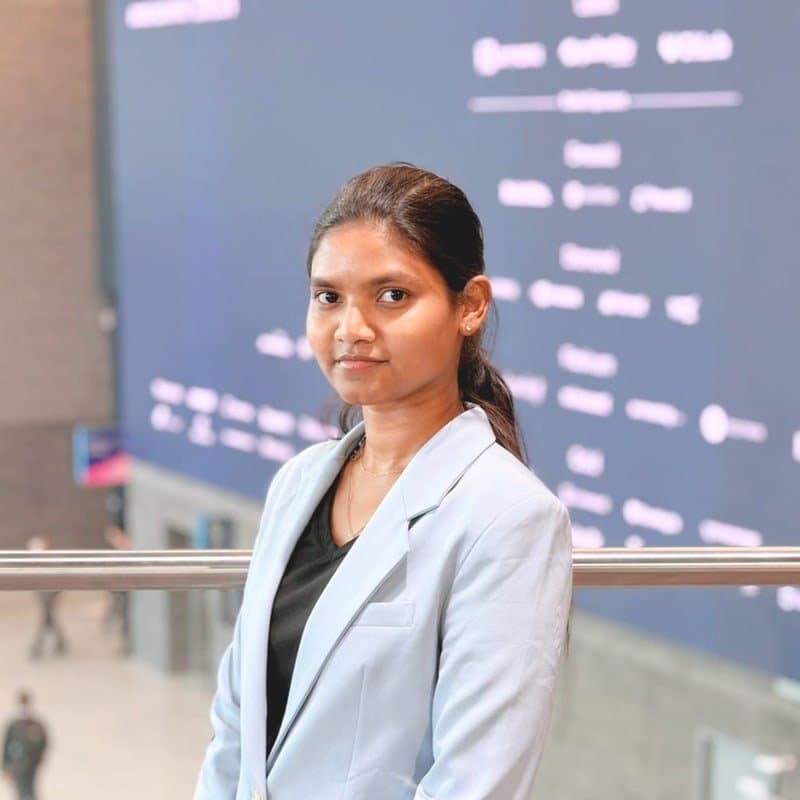
Sudha Rani Maddala
Founder, Vision Assist
MSc Data Science, University of Bristol · Bristol, UK
- Computer vision
- Machine learning
- Python & PyTorch
- YOLO & OpenCV
- Accessibility technology
I’m an applied AI and machine-learning engineer with an MSc in Data Science from the University of Bristol. My work focuses on using computer vision to solve practical accessibility problems.
Through market research, accessibility reports and conversations with potential users, I found the same gap again and again: people want to know what is directly in their path while they keep walking — without buying expensive hardware.
Vision Assist combines my technical background with a problem that has clear social impact. Technology should serve the people who need it most.
Recognition
Top 100
Google Solution Challenge 2024 (team)
For the Vision Assist project
Bristol PLUS Award
University of Bristol
Awarded to the founder
Our values
What we stand for.
Honest about limits
We say when the app is unsure instead of overclaiming, and publish what works and what doesn’t.
Co-designed with users
Blind and partially sighted people shape every feature through interviews, pilots and feedback.
Private by default
Camera video stays on the device wherever possible. Data for training is only ever collected with consent.
Affordable for everyone
A free core experience, with funding and sponsorship so price is never the barrier.
Our journey
How Vision Assist has developed.
- 01Done
Understanding the problem
Mapped the everyday hazards low-vision walkers meet and why stop-and-scan tools fall short.
- 02Done
Prototype app design
Designed a voice-first phone interface: live view, short alerts and a clear-path indicator.
- 03Done
Object detection
Integrated YOLOv8 for real-time detection of people, vehicles and street objects from camera frames.
- 04Done
Spoken alerts
Added alert ranking and text-to-speech so detections become short phrases with direction.
- 05Done
Street field test
Walked a real route in Bristol with voice-started navigation, people and tactile-paving alerts, and a car warning.
- 06Done
Web demo
Ported the model to ONNX so anyone can try detection in their browser, on their own images.
- 07In progress
Hazard-specific model
Training on a custom dataset of poles, curbs, steps and manholes, then publishing honest metrics.
- 08Planned
Depth, offline and more languages
Depth estimation for real distances, on-device processing, multilingual alerts and wearables.
Roadmap
Where we are, and where we’re going.
- DoneDone
Research & prototype
- Problem research and market validation
- Technical feasibility and MVP architecture
- Real-time detection, distance estimation and spoken alerts
- Street field test in Bristol
- 2026Now
Foundation & validation
- Complete hazard models and accessible interface
- User pilot with an initial group
- Partnerships with sight-loss organisations
- 2027Next
Launch & growth
- Public beta for real-world feedback
- Institutional pilots with universities and rehab services
- Commercial launch
Get involved
What we’re looking for.
Pilot participants
Blind and partially sighted smartphone users who want to test it on real routes.
Join the pilotPartners
Charities, mobility specialists, universities and transport operators.
For organisationsFunding & mentoring
Grant funders, accelerators and investors focused on accessibility and AI.
Get in touch
Help us build it right.
We’re looking for blind and partially sighted people to try Vision Assist in a small, supported pilot — and organisations who want to help.
Sign-ups go by email to the founder. Nothing is stored on this website.